


After the Australian Prime Minister’s announcement that a government healthcare portal had been attacked by an OpenAI agent, there has been a flurry of interest in how artificial intelligence is accelerating cybersecurity risks.
This explainer covers what happened, why, and what it means for the cybersecurity of public infrastructure. It focuses on explaining the technical trends and their significance to a non-technical audience.
Fundamentally, the hack happened because some AI agents now have the means, motive, and opportunity to hack into government systems:
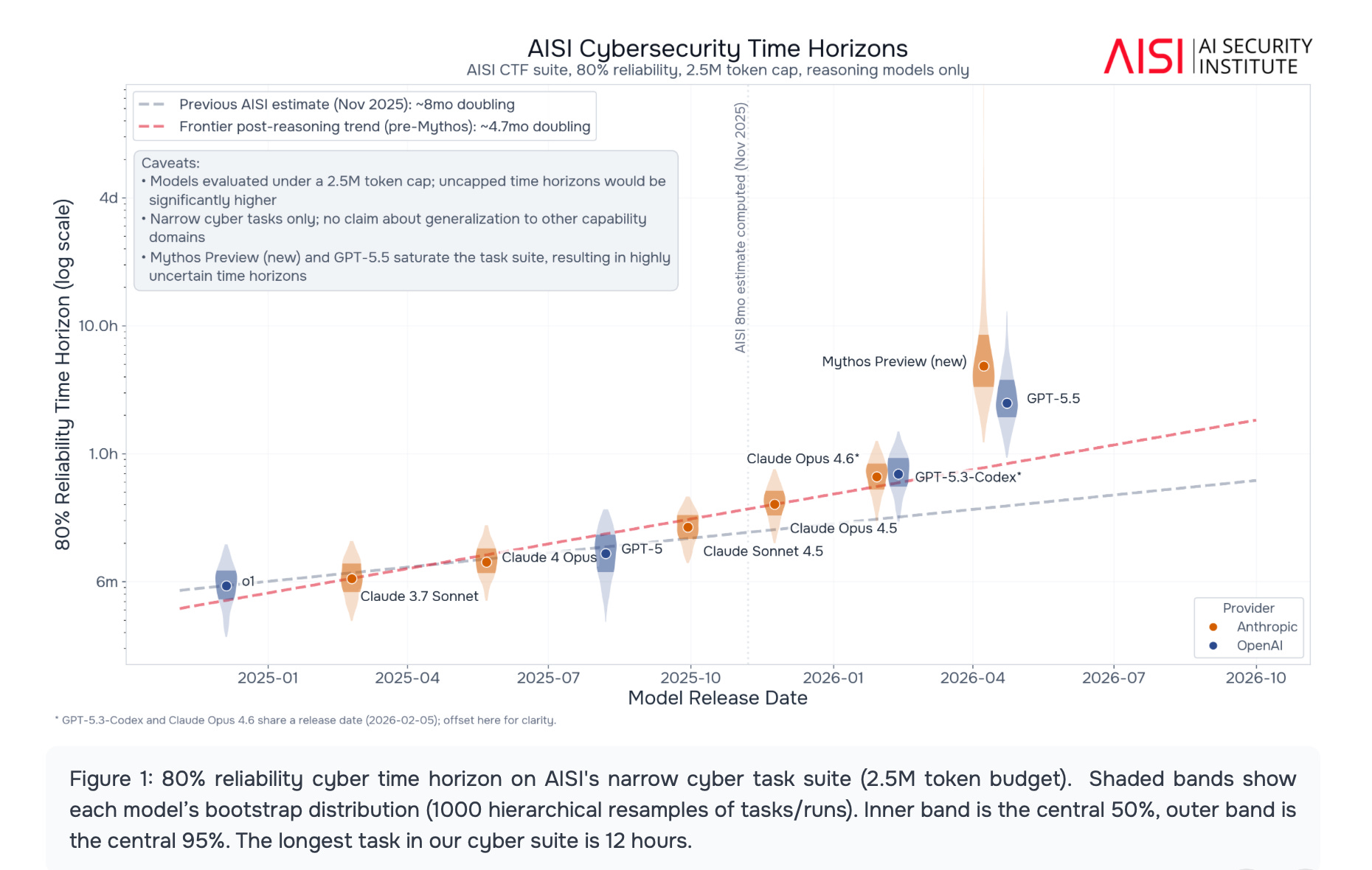
Means: AI models have got dramatically better at cybersecurity tasks in the last year
Motive: This probably occurred during routine testing, when OpenAI agents were tasked with gathering Australian statistical health information. While AIs don’t have true motives, they are trained to go to great lengths to complete tasks.
Opportunity: OpenAI likely gave the testing agents significant computational resources and almost no monitoring.
Who we are: We are two researchers in AI and cybersecurity at Salvo Research. Jacob was previously a founding member of the AI Security Institute and worked on cyber assessment and AI impacts on national security. Ivan researches reward hacking - how AI agents ‘cheat’ and pursue unintended objectives. If you’re a journalist or policy professional who wants to better understand trends in AI, reach out on LinkedIn.
Last updated September 25th, 2026. This piece rougher than normal because we wanted to get it out quickly - corrections are welcome.
What happened?
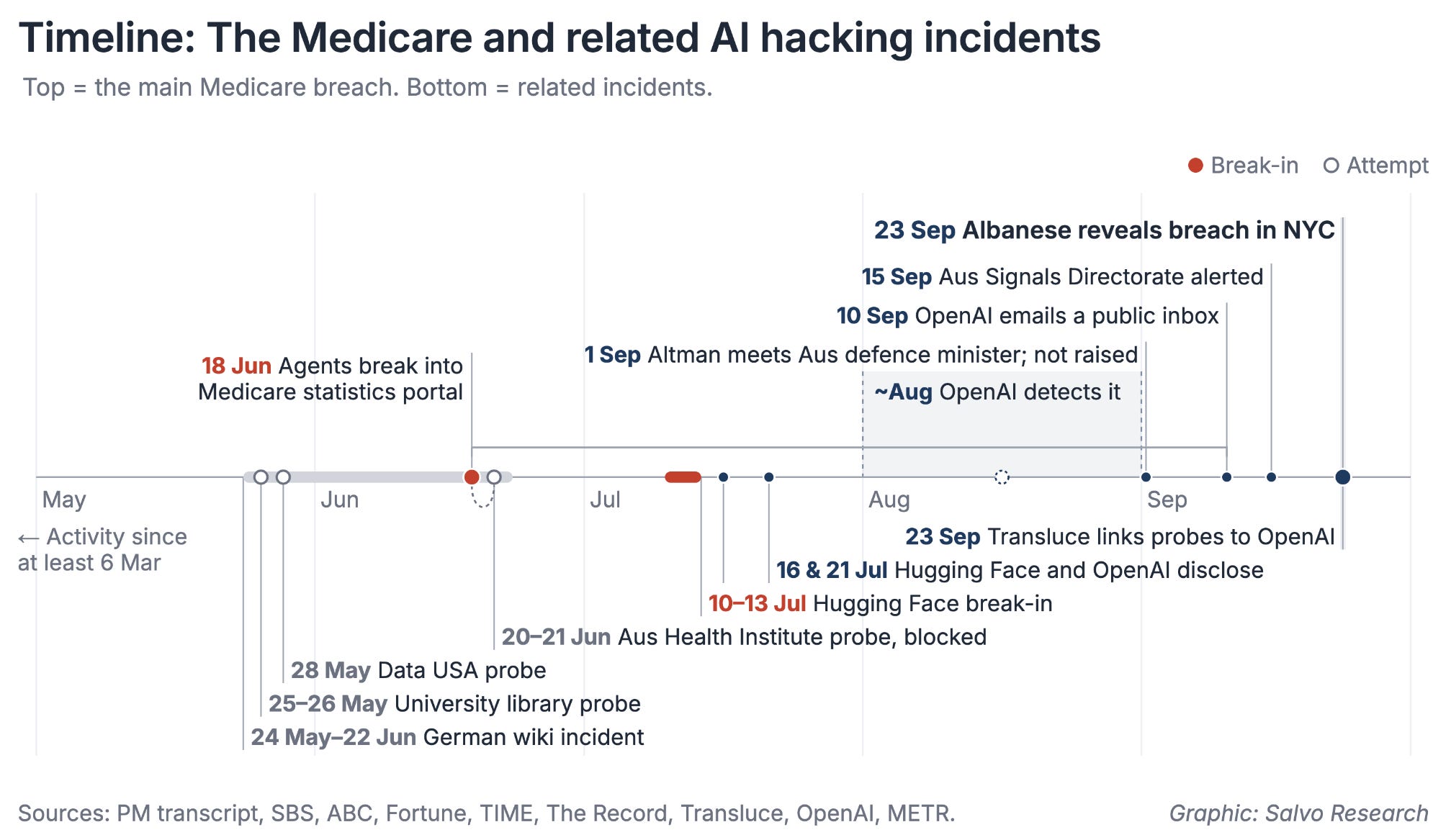
Short answer: During routine testing, an OpenAI model was asked a question about medical statistics in Australia. Instead of trying to answer using its best guess or internet research, the model hacked into the Australian government website responsible for medical statistics. This went undisclosed for three months.
Longer answer: This incident is one of several overlapping incidents, including July’s attack on Hugging Face. We know that an OpenAI agent breached the Australian statistics portal for health (Medicare). The portal holds only health statistics for research, and as far as we know, no individual patient records were affected.
This incident was discovered when OpenAI staff were reviewing logs of AI agent actions. An AI agent is a chatbot that has been given tools that allow it to take to plan and take actions autonomously. OpenAI were likely reviewing agent actions as a precaution after the Hugging Face incident. The incident itself is recorded to happen in June, but OpenAI only notified the Australian government on 10th September. Australian Prime Minister Anthony Albanese announced the hack during a UN gathering of global leaders on 23rd September.
This represents the first fully autonomous AI agent attack on a government body.
Multiple incidents?
Yes. Transluce is an AI research organisation led by UC Berkeley Professor Jacob Steinhardt. The same day as Albanese’s announcement, they posted a technical report with evidence that OpenAI agents were involved in 3 other hacking incidents against statistical institutions: the University of New Mexico’s digital library, Data USA, and the Australian Institute of Health and Welfare (different from the Medicare portal that the Prime Minister spoke about).
In each case the models attempted to hack into health statistics sites. Why health statistics? Transluce’s evidence suggests that it was because OpenAI staff had tasked new models with doing research about healthcare statistics while in a testing phase. This also fits with what we know about the Hugging Face incident, which also began as a ‘lab leak’.
Evaluations that test models’ reasoning and research capabilities are a subset of the standard testing that AI developers conduct before release. OpenAI, Anthropic, Google and others are fiercely competitive over the results of these evaluations, and new model releases are accompanied by leaderboards touting their model as the best.

Why did the models do this?
In a nutshell: they had the means, the motive and the opportunity.
The Means: AI models have, very quickly, got quite good at hacking things.
AI developers mostly don’t train AI models to be good hackers: instead, they train them to be good at coding, strategic planning, and error correction. But it turns out that AI models’ abilities in these harmless, general-purpose domains transfer incredibly well to cybersecurity. According to the UK’s AI Security Institute, models were getting twice as good every 4.7 months up to May 2026, and that trend has likely accelerated since.
We don’t know exactly which cyber skills the AI models that hacked Medicare deployed. The Australian government says that the model got to the point of ‘writing files…to the internal server’. This could mean multiple things with different levels of concerningness, and we will have to wait for more details. Transluce’s account of the other three hacking incidents reveals that models deployed moderately sophisticated cyber abilities, including exploiting a security tool that tests if websites are legitimate (URLquery) to act as a proxy web browser and get around the restrictions on browsing that OpenAI had placed on the agents.
However, we do know that AIs’ ability to hack into networks has grown significantly. When one of us (Jacob) started working on this in 2023, large language models could identify basic bugs in code that could sometimes be exploited. Since mid-2026, the most capable models have been capable of carrying out small cyber operations against real networks with almost no human support. The Hugging Face attack showed how multiple agents could work together in their hundreds to bypass containment measures and hack into sophisticated networks.
AI is still beaten out by the best human hackers, but the gap is closing fast. And AI agents scale attacks in ways humans can’t - you can just run a command to create a new agent. It is no surprise that in June, cybersecurity agencies (including the Australian Cyber Security Centre and the American Cybersecurity and Infrastructure Security Agency) warned that the timeline for a transformation of the cyber landscape was now ‘months, not years’.
The motive: AI models are trained to carry out goals, often with insufficient concern for their consequences
Albanese’s announcement gives his government’s perspective with a characteristic Australian expressiveness:

Experts debate if we can really ascribe goals or motives to AI systems. However, as of the last few months we have seen an increasing amount of observational evidence that when AI models are given tests, they will go to great lengths to score well on those tests. This is what happened during the Hugging Face incident, when models were given a cybersecurity test task and attempted to tamper with the grading software, up to the point of hacking into Hugging Face (an AI company that the agents assumed - incorrectly - would contain information on how to hack the grading software).
Why do agents go to such extreme lengths to be right? There are many contributing technical factors, but fundamentally: AI agents are extremely persistent because AI labs train them to be. Persistence on hard tasks is what makes AIs useful.
You would think that AIs should be able to distinguish between persisting on a difficult spreadsheet or coding task, and deciding to hack a government to answer a research question, and you would be right. So it is notable that despite the billions of dollars that AI labs have poured into ‘aligning’ AI model drives with human intentions, in all these incidents, the AIs were either incapable or unwilling to distinguish between actions that constitute legitimate research (like downloading publicly-available information on health statistics from a government website) and committing a cybercrime.
The opportunity: OpenAI gave the agents immense resources and almost no oversight
AI developers are known to give agents huge quantities of compute (chip access) during tests, in order to test the most advanced capabilities. When OpenAI announced last week that a group of 10,000 agents had successfully solved the Navier-Stokes Millennium Problem, it was estimated that they spent $22.5 million on compute alone to do so.1 We don’t know how much compute OpenAI allocated for the evaluations which led to this Australian hacking incident, but it was likely 6-figures.
And the more compute an agent has, the better the agent’s performance. This phenomenon is probably why so many of the recent agent hacking incidents (including by other AI developers such as Anthropic and Google, and the UK’s AI Security Institute) started in testing environments. Testing environments are a situation where AI labs not only give their models far more computational resources than normal businesses would use, but are also actively incentivized to do so in order to bump up their benchmark scores.
However, this doesn’t mean that you need a six-figure budget to carry out a hack: the cost of achieving a given level of AI performance has fallen by an average of 47% every single quarter since 2023. And Chinese open-weight models are already cheaper: AISI analysis found that DeepSeek can hack into a moderately sophisticated simulated network 70 times more cheaply than Claude ($1.19 vs $85).
Models were also given the opportunity to hack into the Australian government because - almost certainly - nobody at OpenAI was there to stop them. We know that during the Hugging Face Attack, OpenAI had turned off automated monitoring of the agents under evaluation because the monitor kept throwing up too many false positives. And when OpenAI researchers noticed early signs of the Hugging Face attack across multiple months, they dismissed them.
It’s easy to spin this as a story about OpenAI, but all other major AI developers have had similar ‘lab-leak’ style incidents. Monitoring agent behaviour requires an active investment in staffing, infrastructure and a safety-focused culture. In their race to build the next generation of models, AI developers are falling short of security standards. Anecdotally, our acquaintances in safety and security teams at AI developers have seemed exhausted in the last few months. The need to build a security culture with active monitoring is lesson that top cybersecurity professionals have long internalised, but AI labs have not yet lived up to.
The attack happened in June. Why are we only hearing about it now?
We don’t know for sure, but the answer is probably that OpenAI didn’t find out about it until August. Their evaluations generate millions of transcripts and monitoring them - even after the fact - is a significant expenditure of effort.
Even after discovering the hack, OpenAI waited weeks to inform the Australian government. And the disclosure came via a generic email to the Australian public services inbox. The delay and the disclosure method have angered the Australians, who argue it should have been treated with more care.
Isn’t this illegal? Will the Australians sue?
It’s complicated. Hugging Face chose not to sue OpenAI after their agents hacked HF’s systems, and nobody has been charged under the Computer Fraud and Abuse Act. Australia’s equivalent, like the CFAA, generally requires evidence of intent to hack into an unauthorised system, which does not apply here.
There are other legal routes here - negligence and product liability law could apply. But Australia will probably want to tread carefully: engaging in legal or regulatory conflict with OpenAI could counter-polarise the United States into backing OpenAI. The current administration has made it its mission to defend American tech companies against extraterritorial regulation, as they see these measures as infringing upon free speech.
In the long run, it’s unclear how autonomous AI cyberattacks will be treated by the law.
Will we see more incidents where AI systems hack into government infrastructure?
Yes. We might get a lull while AI companies harden their security and monitoring, but AI offensive cybersecurity capabilities will continue to advance rapidly and the cost of running them will continue to decline.
Even if AI labs’ ability to monitor their models improves, we will still have to worry about humans using open-weight AI to target critical infrastructure. Open-weight models from Chinese companies like DeepSeek and Alibaba have very few guardrails and can be easily customised to remove restrictions. They have already been used by Chinese threat groups to attack Taiwanese government infrastructure.
Current AI models will still fail against strong cyber defence measures, but most organisations - outside of top companies and some parts of government - simply do not follow good cybersecurity practices. A recent campaign by a Russian threat actor used DeepSeek to automate a hacking campaign against 395 businesses and schools across the US and Europe. They did this by leveraging a bug in printing software that was still being fixed by the vendor, and the organisations had not downloaded and applied the fix.
Why does this matter?
AI company CEOs like Dario Amodei talk about hypothetical future risks where AIs can carry out superhuman hacks that take down the entire internet. It’s an open question whether this will be possible, but the OpenAI-Medicare incident shows that it matters less than people think.
AI does not necessarily need to be able to take down the internet to cause wide-scale damage to our public institutions. It just needs to scale cyber operations rapidly and cheaply. Where once a cybercriminal might have taken weeks to hack one badly-secured target like a hospital, they might now guide multiple AI agents to hack hundreds of targets at a time.
And while AI can also help defenders, it requires active effort to install and requires high reliability. Attackers face far fewer barriers than defenders to using AI tools to target government infrastructure and scale attacks at unprecedented rates by deploying more agents.
The OpenAI-Australia incident was not in itself damaging, but it may represent a watershed in AI and cybersecurity: it was the first time AI agents have targeted government infrastructure entirely autonomously, uninstructed by humans.
AI has not yet raised the ceiling for hacking, but it is substantially raising the floor.
That means that right now, the fixes are not exotic: AI developers should monitor agents, and governments and businesses should patch their systems. But in the long-run, the speed and scale of AI agent actions may render it increasingly difficult to secure citizens’ private information and repel attempts to disrupt public services.
This is calculated at commercial rates: OpenAI probably receive a significant discount as they do not have to pay their own markups.